Another entry for the IMLDB, the Internet Movie Liturgical Database (like the IMFDB mutatis mutandis). In the 2nd episode of the new TV series Pan Am, from which this screenshot is taken, this is a Catholic Church in 1963 in Paris, France:
Which it's obviously not, but actually Riverside Church in New York City. They haven't even bothered to dress it to look like a Catholic Church in 1963 (6 candles, sanctuary gates, tabernacle for starters).
Addendum: in the a street scene set in NYC in the first episode, I spotted a Muni Meter, first installed in 1999.
Monday, October 03, 2011
Sunday, October 02, 2011
Homer Nods
The New Yorker is famous for its fact checking "et idem indignor quandoque bonus dormitat Homerus." Here's Rebecca Mead writing about Daphne Guinness (subscription only) in the September 26, 2011 New Yorker (my emphasis)
This book was published in 1867. That's a few years before Rowling could have "c[o]me up with the idea."
[Guinness] often wears a veil: "What's great is tying a bit of net around your face, and everything looks like it's in Super 8. It gives a bit of grain to the world." Even before J.K. Rowling came up with the idea, Guinness dreamed of wearing a cloak that would render her invisible.What? Anyone over 25 with a bit of D&D in their misspent youth—or anyone who's read some Tolkien—knows that J.K. Rowling didn't invent the cloak of invisibility. Here's a version from Emily Watson's book Fairies of Our Garden
Saturday, October 01, 2011
There Is No Mafia
The New York Post reports on some religion news:
“Family” health coverage has proven pretty pricey for one high-level mobster.One of the indictments that led to the arrest of more than 120 alleged NY and NJ mobsters last January has more details on the alleged mob involvement.
The third-ranking member of the Colombo crime family is facing an 18-to-24-month prison stint after pleading guilty yesterday to a shakedown scheme designed to cover another mobster’s medical bills after a stabbing.
Richard Fusco, 75, admitted that he joined in a health-care reform “sit-down” of Colombo leaders.
At the meeting -- which was secretly taped by a mob turncoat -- it was agreed that the Gambino crime family would pay the injured mobster’s bills because a Gambino had done the stabbing.
Most of the $150,000 tab was to come from the Gambinos’ illegally skimmed cut of proceeds from the annual Figli di Santa Rosalia celebration on 18th Avenue in Brooklyn, federal prosecutors said.
...
81. It was a part of the scheme that, on or about May 27, 2010, a “Preliminary Income Summary Statement” was submitted on behalf of the Figli di Santa Rosalia, in which the defendant ANGELO SPATA falsely stated that the estimated gross income from vendors’ fees at the 2010 Feast of Santa Rosalia (“Gross Income”) was $51,000, and thus the estimated payment to the City of New York, at 20 percent of the Gross Income, was $10,200, significantly understating the estimated gross income and the estimated payment due. It was a further part of the scheme that following the 2010 Feast of Santa Rosalia, a “Final Income Summary Sheet” was submitted on behalf of Figli di Santa Rosalia, in which a conspirator falsely stated that the Gross Income was $43,000 and the total payment to the City of New York was $8,600, significantly understating the actual Gross Income and the total payment due.The annual festival didn't happen this year.
Friday, September 23, 2011
Anything New Under the Turtle Bay Sun?
I first read poet and novelist May Sarton's memoir Plant Dreaming Deep back in 2003. I've reread it a couple of times since then. It's so good that it's perhaps more accurate to describe Sarton as "memoirist, poet, and novelist". Sarton describes here move to Nelson, N.H., near where I lived as a child and the people she met there and the life they lived starting in 1958.
Wednesday, I started reading a later book of hers, The House By the Sea, which recounts the period from November 13, 1974 to August 17, 1976, after she left Nelson and moved to the Maine seacoast.
It is interesting that I started reading it in this week, when Mahmoud Abbas goes to the United Nations to request full membership in that body for a Palestinian State, for November 13, 1974 is the date of Yasser Arafat's famous address to the U.N. General Assembly. This goes unrecorded in Sarton's journal on the day it occurs, but she brings it up in her December 5th entry. This excerpt starts with Sarton and then quotes at length from an article in the New Statesman, which apparently occasioned the reflection:
Wednesday, I started reading a later book of hers, The House By the Sea, which recounts the period from November 13, 1974 to August 17, 1976, after she left Nelson and moved to the Maine seacoast.
It is interesting that I started reading it in this week, when Mahmoud Abbas goes to the United Nations to request full membership in that body for a Palestinian State, for November 13, 1974 is the date of Yasser Arafat's famous address to the U.N. General Assembly. This goes unrecorded in Sarton's journal on the day it occurs, but she brings it up in her December 5th entry. This excerpt starts with Sarton and then quotes at length from an article in the New Statesman, which apparently occasioned the reflection:
I have a leaden feeling when I wake up and need to shake myself awake like a dog. But the lead is in my mind, of course. It is not only the coming on of winter, but the coming on of old age that I shore up against these days. At all ages we are learning how precarious life is, as it slowly penetrates consciousness that we live in a dying civilization. It was dreadfully borne in on me when the UN allowed Arafat, a holster showing under his shirt, to speak, and so sanctified the most brutal terrorist organization in the world. At that moment something went out of us all in the West. Trust that the generality of nations would stand, at least theoretically, for justice under law? "The Age of Terror," Paul Johnson calls this one in the New Statesman (November 29) Now the truth is out after The Age of Anxiety when we felt vaguely uncomfortable and alarmed. Now the the truth is out—there is no court of higher appeal, no public generality to express revolt. We are all in the same boat and the boat is commanded by thugs. Johnson says,Now there's plenty here to disagree with. The Whig View of History for a start, which plays out in the idea that the West doesn't have an ideal to propose—a consequence of believing Whiggishly that the ideals of the past have been surpassed and discredited. But there's plently to reflect on profitably as well, I think on the day that the Palestinian Leader again goes before the U.N. General Assembly.
"Here we come to the essence of the argument. No state throughout history has had completely clean hands. What marks the progress of civilization is the systematic recognition of laws, the identification and punishment of crime, and the reprobation of the offender. A civilized society is one which sees evil in itself and provides means to eliminate it, where the voice of conscience is active. the horrific record of Britain's indiscriminate bombing of Germany is in part redeemed by the protests of Bishop bell of Chichester. The brutalization of Vietnam by the United States is balanced by the critical millions who eventually brought it to an end. We need not despair at the devastating events of our times so long as we retain the ability to distinguish between right and wrong, between law and disorder, between justice and crime, and proclaim these distinctions from the roof-tops.It is possible, I suppose that we are returning to a Dark Age. What is frightening is that violence is not only represented by nations, but everywhere walks among us freely. One might even make a distinction between terrorism for an ideal or a dream such as the PLO and that which we condone here at home, violence for no reason, as a game or a way of snatching a few dollars. Are we in the West on the way out partly because we have provided our people with almost everything except an ideal.
"The tragedy of the U.N. is that the distinctions have been first blurred, then wholly abandoned; and that its judgements are now delivered not according to any recognized set of principles, however inadequate, but solely in response to the pressures of political and racial groupings. Racialism is condemned in South Africa but applauded in Uganda; and the fruits of aggression are denied or blessed according to the race and political leanings of those to whom they accrue. Thus the UN has become a kind of kangaroo court; far from protecting international order, it undermines it. Not even the wretched League of Nations gave a welcome and a platform to Hitler."
Thursday, September 22, 2011
Potok Compares Himself To...
Chaim Potok describes his relationship to "Catholic" writers in a 1981 interview with S. Lillian Kremer collected in Conversations with Chaim Potok (edited by Daniel Walden)
Potok: ... Interestingly enough, I feel closer to someone like Joyce [than Roth] who really did, in terms of models, precisely what I'm trying to do. Joyce was right at the heart of the Catholic world and at the same time at the heart of western secular humanism. And this confrontation, both as an artist and as a human being in the twentieth century was a core-to-core confrontation. As a human being, he fused his Catholicism with his secularism and produced a Catholic-secular way of writing, if such a thing is possible. His epiphanies, his sacrament of language, the way he structures and sees things are all Catholic, Jesuitical, and he went the secular route through his Catholicism. That didn't happen to me. I stayed inside the Jewish tradition and took the secular into it. He took the Catholic into secularism and I took the secular into Judaism.
Kremer: Do you feel a similar kind of kinship to Flannery O'Connor?
Potok: To O'Connor, and interestingly enough, in no small measure, to Greene, who grapples with the problem of evil in a strange Catholicism. There are models, in this century, for what it is I'm trying to do with my work, but they aren't people like Roth.
Monday, September 19, 2011
Cerealism
WKCR (89.9 FM) at Columbia University has a clever name for their morning classical music program, "Cereal Music"
For related sounded offbeat radio programs: KBOO's Celebration of Dada and Surrealism.
Meanwhile, artist Michael Albert creates collages out of cereal boxes. He calls it... wait for it... “cerealism.”
An eclectic mix of music, spanning the Baroque, Classical, Romantic, and Modern periods. Tune in to hear such composers as Bach, Shostakovich, Bartok, Stravinsky, Schubert, Janacek, Carter, Schoenberg, Haydn, Hindemith, Debussy, Part, Boulez, and many others. From time to time, we present entire shows focusing on everything from 19th century lieder to 20th century string quartets, from Bach's cantatas to Scriabin's piano works, from the American art song to modern Russian masters.They are, of course, punning on "Serialism."
For related sounded offbeat radio programs: KBOO's Celebration of Dada and Surrealism.
Meanwhile, artist Michael Albert creates collages out of cereal boxes. He calls it... wait for it... “cerealism.”
Sunday, September 18, 2011
The Power of Photographs
![]() |
Sid Grossman (American, 1913–1955). Mulberry Street, 1948.Gelatin silver print;33.7 x 26.5 cm (13 1/4 x 10 7/16 in.). The Metropolitan Museum of Art, New York, Purchase, The Horace W. Goldsmith Foundation Gift, through Joyce and Robert Menschel, 1990 (1990.1139.2) www.metmuseum.org |
Sid Grossman's "Mulberry Street" (at right) is part of the show. It depicts the lights and gates of the San Gennaro Festival in Little Italy (coincidentally in its first of two weekends today and tomorrow).
There's some really fascinating work in the show, but it's appeal is damaged by the installation. The room is small and dark with a lowish ceiling and dark blue or black walls. The effect is claustrophobic, even on what was a relatively uncrowded day at the Met. But furthermore, this unpleasant presentation strikes me as unnecessary. Shouldn't part of the point of photographs of the night be that they convey the feeling of the experience when you're not actually in a darkened space?
The relative uncrowded condition of the museum today can be attributed partly to the passing of the seasons from Summer into Fall and partly to the Steuben Parade marching up Fifth Avenue, which made getting to the museum more challenging than usual.
Friday, September 16, 2011
Fr. Dougherty's "Marching Song"
I've been looking at some old copies of The Remnant. The February 28, 1995 issue includes Fr. Eugene J. Dougherty's "'Marching Song' for the Traditionalist Movement." It's written for the tune AUSTRIA (MIDI), also known as the tune for the Kaiserhymne and the German national anthem.
It's not the world's greatest rewrite, but it's at least an historical curiosity and perhaps still has some value as a reassurance/examination of conscience for "traditionalists." I've preserved the somewhat idiosyncratic capitalization and punctuation.
"Lord Preserve the Old Tradition
Lord, preserve the Old Tradition: Save the Mass that stills my soul,
Fills my heart with veneration, guards my Faith and makes it whole.
Let the Church not split in schism; Falsehood, heresy prevent.
In they loving arms, enfold us, in the Blessed Sacrament.
Lord, commend me to Thy Mother, trust me to her loving care,
Lest Thy present crucifixion lead me into dark despair.
Send her forth in Apparition, Comforting the penitent.
In they loving arms, enfold us, in the Blessed Sacrament.
Lord, protect the Holy Father, Give him strength to lead his flock.
While the tempest rages o'er us, shelter us upon this Rock.
Make him strong his Church to shepherd, Make our hearts obedient.
In they loving arms, enfold us, in the Blessed Sacrament.
Lord, restore Thy Holy Priesthood; Raise Melchizedek of old.
Offer up the New Oblation, Which his sacrifice foretold,
Changing bread to thine own Boday, Wine to Blood our nourishment.
In they loving arms, enfold us, in the Blessed Sacrament.
Lord, bestow Thy Benediction, Foretaste of Thy Paradise.
Shining forth in Awesome Beauty, Lo the Holy Sacrifice!
Thus restore the Ancient Mystery, Eucharistic Wonderment
In they loving arms, enfold us, in the Blessed Sacrament.
Thursday, September 15, 2011
Prayer to Overcome Sin in One's Life
The following prayer is printed in the Summer 2011 issue of Cum Petro, the newsletter of the Confraternity of St. Peter (previously) in honor of the Feast of St. Peter in Chains (Aug. 1):
O God, who didst break the chains of blessed Peter the Apostle, and didst make him come forth unscathed, loose the bonds of Thy servant, N., held in captivity by the vice of (Name it); and by the merits of the same Apostle, do Thou grant me to be delivered from its tyranny. Remove from my heart all excessive love for sensual pleasures and gratifications, so that living soberly, justly and piously, I may attain to everlasting life with Thee. Amen.Photo of St. Peter's Chains from Flickr user Alex Beattie under a Creative Commons Attribution 2.0 Generic license.
Monday, September 12, 2011
Searching for Socrates
Adam Kirsch writes about Socrates and the Loeb Library in the Barnes and Noble Review:
Pursuing the figure of Socrates through the Loeb Classical Library leads, then, to troubling conclusions. There's no reason to think that Xenophon's dull moralist or Aristophanes's comic foil is closer to the real Socrates than Plato's philosopher -- rather the contrary, since Plato was the closest to Socrates of any of them. But the three portraits are a reminder that we have no direct access to the real Socrates, whoever he was. We have only interpretations and texts, which both reveal and conceal -- just as ancient Athens has exercised such enormous sway on the imagination of the world based solely on the texts and images it left behind. Even so, the Loebs' promise of completeness is spurious -- after all, the Library can only give us what survives from 2,500 years ago, which is a tiny fraction of what the Greeks and Romans wrote. (We have eleven plays by Aristophanes, but we know he wrote forty.) The image of the Loebs on the bookshelf is an emblem of total knowledge, yet the totality is an illusion -- even if it's the kind of illusion that may be more intellectually empowering than truth.These are clearly the reflections of the literary man Kirsch is. It's not a philosophers way of writing and speaking, but it's interesting nonetheless (and probably for some people, because it's not the philosophical voice!)
For what it is—obviously aimed more squarely at selling books than other literary reviews—I'm impressed with the seriousness and quality of the Barnes and Noble Review for what it is, though it's more .
Saturday, September 10, 2011
Zukofsky, Heine, and Greenberg
I'm awaiting an ordered copy of Louis Zukofsky's poem A. In the meantime, I was reading his Wikipedia page. There, I spotted mention of how
"The final lines of [another poem] Autobiography express Zukofsky's fear of permanent alienation from his upbringing and tradition as a bitter triumph of successful assimilation: 'Keine Kadish wird man sagen'. The lines are a variation on lines from Heinrich Heine’s poem Gedächtnisfeier [Memorial]: 'Keine Messe wird man singen, / Keinen Kadosch wird man sagen, / Nichts gesagt und nichts gesungen / Wird an meinen Sterbetagen'. ('No Mass will anyone sing / Neither Kaddish will anyone say, / Nothing will be said and nothing sung / On my dying days')"That Heine poem is quite interesting. Looking around for a translation, I found that Martin Greenberg's had been published in the New Criterion in 1993. Here is an excerpt:
| Keine Messe wird man singen, Keinen Kadosch wird man sagen, Nichts gesagt und nichts gesungen Wird an meinen Sterbetagen. Doch vielleicht an solchem Tage, Wenn das Wetter schön und milde, Geht spazieren auf Montmartre Mit Paulinen Frau Mathilde. Mit dem Kranz von Immortellen Kommt sie mir das Grab zu schmücken, Und sie seufzet: Pauvre homme! Feuchte Wehmut in den Blicken. ... | No mass will be sung for me, No Kaddish recited either, Nothing said and nothing sung When I depart forever But maybe on a morning when The spring has brought fine weather, Frau Mathilde with Pauline Will walk out in Montmartre. With a bunch of immortelles clutched in Her plump hand, she will come And lay it on my grave and say, Tears in her eyes, “Pauvre homme!” ... |
Tuesday, September 06, 2011
"It was two days before the Nativity of the Mother of God..."
"It was two days before the Nativity of the Mother of God, and they were reciting the litany of the day. It was an inexhaustibly eloquent outpouring of praise for the Virgin, and Yakonov felt for the first time the overwhelming poetic power of such prayers. The canon had been written not by a soulless dogmatist but by some great poet immured in a monastery, and he had been moved not by a furious excess of male hunger for a female body but by the pure rapture that a woman can awake in us."
Solzhenitsyn, In the First Circle, p. 169
Sunday, July 24, 2011
War Bonds and the Debt Ceiling
At the Metropolitan Museum this afternoon, looking at this and that.
In passing in the hallway, we saw war bond posters that are part of the excitingly titled exhibition, "Drawings and Prints: Selections from the Permanent Collection". The selection on show is described this way on the Met's web site: "Also on view will be a group of World War I posters that focus on the ever-changing image of the Statue of Liberty..."
What struck me, however, in the midst of the debate over raising the federal debt ceiling was the difference in tone from our current debate. America had a great goal it was seeking to achieve--winning the World War. It raised the money the politicians felt they needed not only by raising tax revenue--though they certainly did that too--but by persuading Americans that America was a good bet and getting them to pony up their own cash voluntarily as a loan to the government.
This post would be better with photos. Another reason my next phone will be fancier!
In passing in the hallway, we saw war bond posters that are part of the excitingly titled exhibition, "Drawings and Prints: Selections from the Permanent Collection". The selection on show is described this way on the Met's web site: "Also on view will be a group of World War I posters that focus on the ever-changing image of the Statue of Liberty..."
What struck me, however, in the midst of the debate over raising the federal debt ceiling was the difference in tone from our current debate. America had a great goal it was seeking to achieve--winning the World War. It raised the money the politicians felt they needed not only by raising tax revenue--though they certainly did that too--but by persuading Americans that America was a good bet and getting them to pony up their own cash voluntarily as a loan to the government.
This post would be better with photos. Another reason my next phone will be fancier!
Sunday, July 17, 2011
Why I Stay Out of Bookstores (or should)
Mutatis mutandis, though not quite so dire:
Even though we get a lot of people into the shop, only a small percentage of them buy anything. The best customers are the ones who just have to buy a record on a Saturday, even if there's nothing they really want; unless they go home clutching a flat, square carrier bag, they feel uncomfortable. You can spot the vinyl addicts because after a while they get fed up with the rack they are flicking through, march over to a completely different section of the shop, pull a sleeve out from the middle somewhere, and come over to the counter, this is because they have been making a list of possible purchases in their head ("If I don't find anything in the next five minutes, that blues compilation I saw half an hour ago will have to do"), and suddenly sicken themselves with the amount of time they have wasted looking for something they don't really want. I know that feeling well (these are my people, and I understand them better than I understand anybody in the world): it is a prickly, clammy, panicky sensation, and you go out of the shop reeling. You walk much more quickly afterward, trying to recapture the part of the day that has escaped, and quite often you have the urge to read the international section of a newspaper, or go to see a Peter Greenaway film, to consume something solid and meaty which will lie on top of the cotton-candy worthlessness clogging up your head.
High Fidelity by Nick Hornby
Friday, July 15, 2011
Traditional Catholics: Just Like Spies
A quote from the former head of MI5 reported in The Telegraph sounds just like some folks I know:
via Jay Nordlinger
One Dartington audience member asked Dame Stella for her opinion of security services in other countries. She replied: “The Italians were all ex-admirals and terribly courteous - lots of hand-kissing and bowing. The French were extremely good and seemed able to do anything. We worried about laws, they seemed able to do exactly what they liked so we rather envied them.”I think we can conclude that traditional Catholics are just like spooks in these respects.
via Jay Nordlinger
Thursday, July 14, 2011
Shrimp and Watermelon
Shrimp and watermelon was a combination new to me. It was one of the fun flavor combination dishes that we ate last night at Queen's (relatively) new Salt and Fat restaurant. Another was pork buns with apricot mustard. The buns themselves, meh, but the apricot mustard idea (with or without pork) I can really get behind.
But to return to shrimp and watermelon, today I get this in my e-mail from Havana Central:
![]()
a promotion for a "Watermelon Fiesta" featuring shrimp and watermelon. Is this some new trend? Nope, it goes back a ways. Here's a related recipe on Google Books from 1998. So not as creative as I thought, though still darn tasty.
But to return to shrimp and watermelon, today I get this in my e-mail from Havana Central:
a promotion for a "Watermelon Fiesta" featuring shrimp and watermelon. Is this some new trend? Nope, it goes back a ways. Here's a related recipe on Google Books from 1998. So not as creative as I thought, though still darn tasty.
Saturday, July 09, 2011
Pot of Gold at the End of the Ethernet Cable
Back in the days of MUDs and MUSHs there was a story going around about a guy—addicted to cocaine—who got so addicted to MUDding that when his "friends" laid out a line of cocaine next to his keyboard he couldn't stop playing long enough to sniff it.
But a couple of weeks ago, I read in the New York Observer the most outrageous internet overuse story since those days.
Here it is:

Bitcoins are a virtual currency, created (or "discovered") by solving a mathematical problem with a computer. People can use their home computer setups (very powerful home computer setups) to create new coins and that's what caused the accident in this case. A later post on BitcoinMiningAccidents.com provides more details.
The gold standard is the most exhausting topic in politics, but discussion of Bitcoins has the potential to combine all that economic wonkery with hard core computer nerd-dom. Bitcoins may take over the world, but only if everyone doesn't fall asleep first.
But a couple of weeks ago, I read in the New York Observer the most outrageous internet overuse story since those days.
Here it is:
One college student sustained permanent minor brain damage due to heatstroke after he dozed off in his room next to four computers furiously mining Bitcoins. “I wish I was joking,” he said in a forum post that was reposted on the website BitcoinMiningAccidents.com.

Bitcoins are a virtual currency, created (or "discovered") by solving a mathematical problem with a computer. People can use their home computer setups (very powerful home computer setups) to create new coins and that's what caused the accident in this case. A later post on BitcoinMiningAccidents.com provides more details.
The gold standard is the most exhausting topic in politics, but discussion of Bitcoins has the potential to combine all that economic wonkery with hard core computer nerd-dom. Bitcoins may take over the world, but only if everyone doesn't fall asleep first.
Friday, July 08, 2011
You Can Buy Lots of Hats for 2,000 Sestertii
Caesar militibus pro tanto labore ac patientia, qui brumalibus diebus itineribus difficillimis, frigoribus intolerandis studiosissime permanserant in labore, ducenos sestertios, centurionibus tot milia nummum praedae nomine condonanda pollicetur legionibusque in hiberna remissis ipse se recipit die XXXX Bibracte.Caesar might have saved himself a bit of money if he'd outfitted his troops in warm and stylish knit hats like this from Etsy:
C. Iuli CaesarisCommentariorum De Bello GallicoLiber Octavus ab A. Hirtio scriptus
Thursday, July 07, 2011
New Independent High School to Open in Norwalk
The Society of St. Hugh of Cluny posted this news a few months ago: New Independent High School to Open in Norwalk:

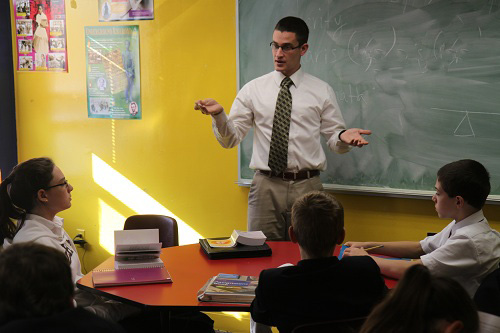
A new independent Catholic high school, Cardinal Newman Academy, will open this fall in Norwalk, CT. The school will be closely connected with the highly successful independent Catholic elementary school, Anchor Academy. The photo above is a scene from an Anchor Academy classroom. The idea for the school arose from the desire among parents to provide a high school program for the graduates of Anchor Academy and to any students who are interested in receiving a solid Catholic, academic education. This fall the school will have a 9th grade, with plans to add a new grade each year until the school is complete. Anyone who is interested can direct inquiries to Kristjana Underhill, 203-536-3800 or krinkasig@hotmail.com.This is really great news. Catholic schools with authentic Catholic distinctives are our chief weapon (o.k., amongst our weaponry) for building Catholic culture and Christian society.
Tuesday, July 05, 2011
Noli Me Tangere
Many months later, I've finally finished reading José Rizal's, Noli Me Tangere. I don't recommend it. Aside from the setting, it feels derivative of writers like Dumas and Hugo.
It's place in the literary canon, enshrined in the Penguin Classics, is similar, it seems to me, to that of Uncle Tom's Cabin. They are books that are politically important, but not only secondarily artistically interesting, if at all.
Harold Augenbraum's introduction in this edition is interesting and useful, but the notes are idiosyncratic, one example suffices. Rizal's biblical quotations from the title on are offered in Latin. Augenbraum has used the King James Version to provide translations rather than the Douay or another Latin-based edition.
I wrote a previous post about anti-clericalism in the novel, which can be found here.
It's place in the literary canon, enshrined in the Penguin Classics, is similar, it seems to me, to that of Uncle Tom's Cabin. They are books that are politically important, but not only secondarily artistically interesting, if at all.
Harold Augenbraum's introduction in this edition is interesting and useful, but the notes are idiosyncratic, one example suffices. Rizal's biblical quotations from the title on are offered in Latin. Augenbraum has used the King James Version to provide translations rather than the Douay or another Latin-based edition.
I wrote a previous post about anti-clericalism in the novel, which can be found here.
Subscribe to:
Posts (Atom)