Thursday, July 08, 2010

Video and Audio from the Met Museum

The inanity of Youtube comments is legendary, but this one is pretty high up there:
i went to see this this past weekend.. was prob the most interesting part of the whole museum..
The "this" in question? The current Picasso exhibit at the Metropolitan Museum of Art. It's a comment on Thomas Campbell and Gary Tinterow's video tour of the exhibit. There's so much at the Met. This is not the most interesting thing going on there! It's not even that special as an exhibition of Picasso's work, being a show just of works already in the Museum's collection.

On a recent visit, I found Side by Side: Oberlin’s Masterworks at the Met to be particularly fascinating. More on that in a future post, I hope.

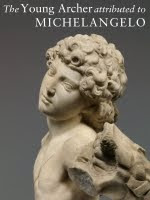
But first, here's a bit of media from the Met's web site that I did really like. In an MP3 podcast, curator James Draper discusses Michaelangelo's "Young Archer": how it was rediscovered and how it ended up on display at the Met.

Somewhat Surprised He Stuck Around

Wow. Bill Buckley tears into Norman Mailer in his introduction to their interview in this episode of Firing Line.


This Youtube playlist has all six parts.

Friday, July 02, 2010

Why July?

Why is July 1st the Feast of the Precious Blood?

"Fr. Hunwike's Liturgical Notes" has the answer, which I had forgotten, if I ever knew it:
...surely one of the most crass examples of the Hermeneutic of Rupture incarnated in the Bugnini 'reforms' [was] ... when, with immense cynicism, the 'reformers' reduced July 1 to a feria on the flippant grounds that the Precious Blood would get a perfectly adequate 'covering' by being merely added to the title of Corpus Christi. Thus a nice piece of Pius IX liturgy disappeared: the memorial he placed on the calendar to commemorate his return to the City after the Roman Revolution of 1848. There is nothing vulgar, incidentally, about doing that sort of thing to the calendar, or, if there is, it is simply the vulgarity of an incarnational religion.
Pius IX assigned the feast to the first Sunday in July, Pius X moved it to July 1 as part of his effort to put back into use Sunday Masses of the Roman Missal that were frequent impeded.

Monday, June 28, 2010

I love that Armond White...

...just doesn't care what other people think about him.  Or maybe he does.  But he certainly doesn't care a lot about what the Masses think about him.  I don't agree with everything in his review of Toy Story 3 (which movie I rate O.K., not good, and certainly not great.)

Of course, he makes me love him right off the top by referencing a Whit Stillman film:
Pixar has now made three movies explicitly about toys, yet the best movie depiction of how toys express human experience remains Whit Stillman’s 1990 Metropolitan. As class-conscious Tom Townsend (Edward Clements) tries fitting in with East Side debutantes, he discovers his toy cowboy pistol in his estranged father’s trash. Without specifying the model, Stillman evokes past childhood, lost innocence and Townsend’s longing for even imagined potency.

Here's some more:
Look at the Barbie and Ken sequence where the sexually dubious male doll struts a chick-flick fashion show. Since it serves the same time-keeping purpose as a chick-flick digression, it’s not satirical. We’re meant to enjoy our susceptibility, not question it, as in Joe Dante’s more challenging Small Soldiers. Have shill-critics forgotten that movie? Do they mistake Toy Story 3’s opening day for 4th of July patriotism?

When Toy Story 3 emulates the suspense of prison break and horror films, it becomes fitfully amusing (more than can be said for Wall-E or Up) but this humor depends on the recognition of worn-out toys which is no different from those lousy Shrek gags. Only Big Baby, with one Keane eye and one lazy eye, and Mr. Potato Head’s deconstruction into Dali’s slip-sliding “Persistence of Memory” are worthy of mature delectation. But these references don’t meaningfully expand even when the story gets weepy. The Toy Story franchise isn’t for children and adults, it’s for non-thinking children and adults. When a movie is this formulaic, it’s no longer a toy because it does all the work for you. It’s a sap’s story.
Just go read it already.

So where we started this post--that Armond White just doesn't care what other people think--is reflected in the comments on Rotten Tomatoes on his review, all 800 of them. The negative ones are just vicious. People are trying to petition Rotten Tomatoes to not include White in their aggregation.

Oh, and for some more Whit Stillman, check out this 2009 interview with Stillman on WNYC when The Last Days of Disco was released on DVD as part of the Criterion Collection. I made a special trip to Barnes and Noble to buy it the day I heard this interview on the radio.

The trailer is terrible and gives almost no true sense of the film, so instead here's a clip from the film that is more representative:


In addition, you should read--who else's?--Armond White's review, though this copy is laden with typos, some of which I've corrected in this sample:
These are Stillman's fullest, most daring characters yet. Alice and Josh's first private talk ("I take no for an answer," he tells her when she teases) contains bold, humanist risk. Describing himself as a loon, Josh recites a hymn, then makes the sound of a bird, swaying off balance as he walks down the street, "You think I'm wacko?" he asks, taking Alice inside his loneliness, and her sad look communicates a shared confidence. Contemporary movies rarely get as intimate as that and Stillman goes further. English actress Kate Beckinsale achieves a striking American bitch transformation: Sleek, haughty and precipitate, her churning insecurities are protected by an impeccable, inherited facade. Beckinsale's Charlotte constantly abrades and one-ups her initial infatuations, yet Stillman shows a side of her character--she sings--that takes the entire comedy of manners into unexpected territory, revealing a suppressed cultural background that explains these urbane pilgrims at both their best and worst.

You can also check out this previous Whit Stillman post from March 2009. I also name checked Last Days in discussing Shattered Glass in 2004.

Thursday, June 24, 2010

Jesuitica in Goethe

I've just started reading Goethe's Italian Journey.  My copy is the Penguin edition of W.H. Auden and Elizabeth Mayer's translation.  The translation is noteworthy, because of the topic of this post, Jesuitica in Goethe, and because of this note in the translators' introduction:
One previous translator, an Anglican clergyman, omitted all favourable references made by Goethe to the Roman Catholic Church; we have confined ourselves to stylistic matters.(pg. 18)
And grateful we to Auden and Mayer we should be, for we find this pearl in the first chapter (though in fairness, it is in at least one earlier translation too):
The first thing I did [in Regensburg, Germany] was to visit the Jesuit College, where the students were performing their annual play. I saw the end of an opera and the beginning of a tragedy. The acting was no worse than any other group of inexperienced amateurs, and their costumes were beautiful indeed, almost too magnificent. Their performance reminded me once again of then worldly wisdom of the Jesuits. They rejected nothing which might produce and effect and they knew how to use it with love and care. Their wisdom was no coldly impersonal calculation; they did everything with a gusto, a sympathy and personal pleasure in teh doing, such as living itself gives. This great order had organ-builders, wood carvers and gilders among its members, so it must also have included some who, by temperament and talent, devoted themselves to the theatre. Just as they knew how to build churches of imposing splendour, these wise men made use of the world of the sense to create a respectable drama. (pg. 24)
I know Jesuits and I know organ-builders. Sadly I don't know any Jesuit organ-builders. I do know a Jesuit actor and theater technician though, which adds to the awesomeness of discovering this passage.

A paragraph further on he returns to the topic of the Jesuits:
I keep thinking about the character and the activities of the Jesuits. The grandeur and perfect design of their churches and other buildings command universal awe and admiration. For ornament, they used gold, silver, and jewels in profusion to dazzle beggars of all ranks, with, now and then, a touch of vulgarity to attract the masses. Roman Catholicism has always shown this genius, but I have never seen it done with such intelligence, skill and consistency as by the Jesuits. Unlike the other religious orders, they broke away from the old conventions of worship and, in compliance with the spirit of the times, refreshed it with pomp and splendour.
Ooh, we were with you right up until the last sentence, sir! It presents some difficulties.

The painting is J. H. W. Tischbein's Goethe in the Roman Campagna, 1787.

Sunday, June 20, 2010

An Unusual Privilege

An unusual privilege for missionary priests in China, permission to wear the biretta at the altar while celebrating Mass:

Monday, June 07, 2010

The Clergy in the Corpus Christi Procession

Post updated to provide context for anyone not coming here from the NLM comment thread.

In response to a post on the New Liturgical Movement a commentator asked this question:
I just saw some pictures from a Corpus Christi procession at an FSSP apostolate in France. There were three additional priests in attendance. They were all wearing chasubles over surplices (not albs). I can't recall ever having seen this done, and I was wondering if anyone here can offer an explanation. Could it be because they lacked a sufficient number of white copes, and if that's why, is there a rubrical provision to allow chasubles in place of copes where copes are not available?
Gregor points out:
Under the rubrics of the usus antiquior, the canons of a cathedral chapte wear for the Corpus Christi procession the vestments corresponding to their rank in the chapter (the so called canonici parati, much like there are Cardinal deacons, priests and bishops, who used to wear the corresponding vestments for certain papal functions).
Having just looked at this question (and many, many others) in preparation for the Corpus Christi procession at Holy Innocents, I could point right away to the citation on pg. 388 of the 15th edition of Ceremonies of the Roman Rite:
"If the cathedral chapter assists, the canons out to wear vestments of their three orders; that is, subdeacons in tunicles, deacons in dalmatics, priests in chasubles; dignitaries in copes.(31) These are put on after the communion of the Mass and should be worn immediately over the rochet and an amice, without stole or maniple, as when the Ordinary sings solemn mass. The colour of the vestments is white. If the cathedral chapter is not present the clergy may be divided into groups wearing these vestments. (32)" [My emphasis]

Footnote 31: C.E., II, xxxiii, 5.
Footnote 32: Cf. S.R.C. 2362 Section 1.
That second footnote also seems to drive the wearing of albs instead of surplices as one might expect in place of the rochet. S.R.C. 2362 is now easily available via Google Books. Here's the relevant excerpt from the Decreta authentica.


Click the link to see the decree in the context of the book via Google Books.

This is just wrong...

...For Love of the Game dubbed in French:


I hadn't realized that the movie is based on a novel by Michael Shaara, author of the Pulitzer Prize-winning The Killer Angels.

Sunday, June 06, 2010

Corpus Christi Notes

Two notes about Corpus Christi, for which we finished today three exhausting liturgies, first a Solemn Mass an outdoor procession on Thursday, then today the External Solemnity in the old rite and the Feast in the new rite (with a reception into full communion, confirmations and first Communions thrown in for good measure.)

First, in preparing for Thursday's Mass I came across this story on the web site Thesaurus Precum Latinarum:
The rhythm of the Pange Lingua is said to have come down from a marching song of Caesar's Legions: "Ecce, Caesar nunc triumphat qui subegit Gallias."
As they say on Wikipedia, "citation needed", but interesting idea. If I were a liturgy scholar, I'd be interested in exploring the idea of to what extent Roman ideas of processions arise from the processions of classical Rome, either organically, from the time of the Empire or through later classicizing influence on the liturgy.

Second, I dug into, for what was for some reason the first time, the whole of the Corpus Christi sequence. There's a lot of theological meat there, in a way that reminds me of the Quicumque. Here's the Sequence, called "Lauda Sion" after its first two words in Latin, in English translation from Hymns of the Breviary and Missal (Britt, 1922) (with some light editing I did for our service leaflet this morning):
Lauda Sion: The Corpus Christi Sequence

Praise, O Sion, thy Saviour, praise thy Leader and thy Shepherd in hymns and canticles.

As much as thou canst, so much darest thou, for He is above all praise, nor art thou able to praise Him enough.

Today there is given us a special theme of praise, the Bread both living and life-giving.

Which, it is not to be doubted, was given to the assembly of the brethren, twelve in number, at the table of the holy Supper.

Let our praise be full and sounding; let the jubilations of the soul be joyous and becoming.

For that solemn day is now being celebrated, on which is commemorated the first institution of this table.

At this table of the new King, the new Pasch of the New Law puts an end to the ancient Pasch.

The new supplants the old, truth puts to flight the shadow, day banishes night.

What Christ did at that Supper, the same He commanded to be done in remembrance of Him.

Taught by His sacred precepts, we consecrate bread and wine into the Victim of salvation.

This is the dogma given to Christians, that bread is changed into Flesh and wine into Blood.

What thou dost not understand, what thou dost not see, a lively faith confirms in a supernatural manner.

Under different species in externals only, and not in reality, wondrous substances lie hidden.

Flesh is food, Blood is drink: nevertheless Christ remains entire under each species.

By the recipient the whole (Christ) is received; He is neither cut, broken, nor divided.

One receives Him; a thousand receive Him: as much as the thousand receive, so much does the one receive; though eaten He is not diminished.

The good receive Him, the bad receive Him, but with what unequal consequences of life or death.

It is death to the unworthy, life to the worthy: behold then of a like reception, how unlike may be the result!

When the Sacrament is broken, doubt not, but remember, that there is just as much hidden in a fragment, as there is in the whole.

There is no division of the substance, only a breaking of the species takes place, by which neither the state nor stature of the substance signified is diminished.

Lo, the Bread of Angels is made the food of earthly pilgrims: truly it is the Bread of children, let it not be cast to dogs.

It was prefigured in types,—when Isaac was immolated, when the Paschal Lamb was sacrificed, when Manna was given to the fathers.

O Good Shepherd, True Bread, 0 Jesus, have mercy on us: feed us and protect us: make us see good things in the land of the living.

Thou who knowest all things and canst do all things, who here feedest us mortals, make us there be Thy guests, the co-heirs, and companions of the heavenly citizens.
You can find the full text of the book here via the Church Music Association of America, which also has additional commentary on this sequence and on many other hymns.

Saturday, June 05, 2010

EF, TLM, or what?

There's been a lot of talk over the years about what to call Mass and sacraments celebrated according to the 1962 Missal and the former version of the Roman Ritual. Here's one usage from a surprising source:
Then there was also the old rite in which the power to forgive sins was conferred at a separate moment. It began when the Bishop, pronouncing the Lord's words, said: "No longer do I call you servants... but... friends". And I knew we knew that this is not only a quotation from John 15 but a timely word that the Lord is addressing to me now. He accepts me as a friend; I am in this friendly relationship; he has given me his trust and I can work within this friendship and make others friends of Christ.
Yep, that's Pope Benedict XVI calling it "the old rite".

Saturday, May 22, 2010

Blunt Talk

Who knew? Commencement addresses are good for something. Rep. Roy Blunt (R-MO), speaking at Southwest Baptist University:
For more than three decades Congress has continuously renewed the Hyde Amendment, which keeps federal Medicaid funds from paying for elective abortions. The new health-care law gets around that ban by creating new funding streams to which the amendment does not apply, and new policies now use our tax dollars abroad to fund groups who promote abortion.

It is time to make the late Henry Hyde’s amendment permanent law and apply it to all operations of the federal government. It is the bare minimum that we should do to protect both unborn life and the conscience of American citizens who don’t want to be forced to facilitate the ending of a life.
Makes sense to me.

Nota Bene: Roy Blunt is not to be confused (as I did once) with Roy Blount, Jr., the humorist I know best from his regular appearances on Wait, Wait, Don't Tell Me, but who I also bizarrely saw quoted on the menu at Pizzeria Uno tonight. More on that dinner tomorrow.

(via The Corner)

Tuesday, May 18, 2010

Crowned a Winner in King's Cuts

There has been a lot of concern about the restructuring and job cuts at King's College in London in the Philosophy world as well as among paleographers.

But one at least one victor has emerged. The final report is out, which notes:
Classics will work closely with the new Centre for Hellenic Studies and will house one of the joint appointments. As the largest and most diverse UK Classics department outside Oxford and Cambridge, it will retain its full range of specialisms, including its current complement in Classical Archaeology and Art. It will benefit from the appointment of a new lecturer in Latin language and literature to respond to strong (and growing) student demand in this area.
So there's at least a glimmer of hope for Western civilization.

Sunday, May 16, 2010

Just what the world needs...

...a nice pocket edition of George Berkeley's Three Dialogues Between Hylas and Philonous:


I love this book, but even I could have told them it wasn't a publishing winner. It is, as one might expect on the remainder tables at the Strand.

Tuesday, May 11, 2010

Ascension Thursday

Fr. Z has published his annual rant about the practice of moving the observation of the Feast of the Ascension from Thursday to Sunday.  This is silly he argues (correctly), since the feast was fixed for 40 days after Easter (a Thursday) from the late 4th century, reflecting that Christ appeared for 40 days after the Resurrection (Acts 1:2).  Pentecost, as implied by its name is celebrated 50 days after Easter on Sunday.

Thankfully here in the Ecclesiastical Province of New York, we've kept the traditional day, as have some other northeastern provinces and the Province of Omaha.

Fr. Z. misses, however, I believe, one part of why this change was sold so easily to much of the United States.

Before the calendar reforms of 1955, Ascension was celebrated with an octave. This meant that the Sunday following the Feast of the Ascension was a continued part of the celebration of the Ascension.  This celebration carried through all the way to the next Thursday.  Then you had two penitential days of preparation, a Friday and the Vigil of Pentecost, before the celebration of the Great Feast of Pentecost.  But with the "Sunday after Ascension" being just another Easter Sunday (of which we've already had a great many), the end of the Easter season is left rather shapeless.

Now, I don't advocate for moving the Feast of the Ascension to Sunday, but I can sort of understand why they do it.  There's something missing in those last weeks of Easter and shifting Ascension helps fill the emptiness.  You can guess what my solution would be...

Now for some appropriate music by Messiaen to accompany this post:


More Mike (Masonry)

I wanted to add one humorous aside to yesterday's commentary on Mike Potemra's post about predestination on The Corner.  He writes about author John Salza:
Just how conservative a Catholic is Mr. Salza? This should give some indication: Among his earlier books are Why Catholics Cannot Be Masons and The Biblical Basis for Purgatory.
While I'd hope explaining the biblical basis for purgatory isn't a particularly conservative concern, the Freemasonry thing does continue to be amusing. 

When Baronius brought out a book on Freemasonry a while back, we joked that you're not really a traditionalist publishing house until you have a book on your list about the evils of Freemasonry. This despite Masonic plots not being high on the list of things most people, even traditionalists, worry about these days.

Monday, May 10, 2010

Potemra on Predestination

I'm glad to see that Mike Potemra bringing up the forgotten doctrine of predestination in a post over at National Review Online. He's posting about a new book from TANThe Mystery of Predestination According to Scripture, The Church, and St. Thomas Aquinas, by John Salza. However, his conclusion doesn't seem to be true at all.  Poterma writes:
[T]hat a Catholic writer is not afraid to deal so forthrightly with the central Reformation emphasis — that man is not loved by God because of any merit of which man himself is the source and author — is another indication that the ecumenical spirit is bearing rich fruit in our times.
Catholic writers have been dealing forthrightly with predestination all along.  Here are some modern guideposts:
This isn't really the fruit of ecumenism, it's just the continued handing on of the tradition.  In fact, Most and Akin's work (and perhaps to a degree Ott's) are part of an apologetic project that is in some ways opposed to much of what passes for ecumenism these days. Anyways, it's not as if we've suddenly started paying attention to John Piper and Marc Driscoll and rediscovered a biblical doctrine we'd forgetten about.  While I don't think that's what Potemra intended, it's not an entirely implausible way to read what he wrote.
I don't want to miss linking to these useful pre-Reformation texts:
Addressing one of Potemra's other points:
But — unlike some other doctrines that are baffling to the intellect, such as the Trinity — this doctrine is rarely mentioned in Catholic pulpits and publications. (It has fallen into desuetude even among Protestants. I was, for almost three years, a member of a Presbyterian congregation — in the denomination gently mocked as “God’s frozen chosen” for its past emphasis on predestination — and, in three years of Sundays, it was mentioned in exactly one sermon. ...
Fr. Al Kimel (whose ordination I attended back in 2006) ran a series of articles on predestination on his blog Pontifications.  In part III, he tackles the difficulties of preaching the doctrine of predestination.  And its importance:
James Daane has explored the unpreachability of predestination in his book The Freedom of God: A Study of Election and Pulpit (1973). “Sermons on election are so rare,” Daane writes, “that even a regular churchgoer may never hear one…. And the rare occasion when a minister does venture to preach on election is more likely to be an apologetic lecture defending a particular form of the doctrine than a sermon proposing election as something in which the hearer should place his faith and ground his trust” (p. 14). This last sentence is important. In the New Testament predestination is not so much a doctrine to be taught as good news to be proclaimed. When the Apostle Paul writes that “those God foreknew he also predestined to be conformed to the likeness of his Son … And those he predestined, he also called; those he called, he also justified; those he justified, he also glorified” (Rom 8:29-30) he was not engaging in a bit of abstract theological speculation; he was proclaiming gospel to the believers in Rome and offering a powerful word of hope and encouragement. God has predestined you to glory! Therefore, you need not fear “trouble or hardship or persecution or famine or nakedness or danger or sword” (Rom 8:35). The biblical language of predestination is first- and second-person discourse. It is a way of speaking the gospel to those who have died with Christ in Baptism and been raised to new life in the Church.
Fr. Kimel has more interesting stuff (though I'm not sure I agree with all of it) in part IV, about bringing back preaching about predestination.

Saturday, May 08, 2010

More and different links...

I've updated the sidebar!

Some More Catholic History

This undated (but apparently pre-1969) photo comes from a Flickr set of a Catholic wedding held at St. Francis Xavier Church in Kansas City Missouri (good pictures of the interior as it is today).


It's an interesting piece of liturgical history.  First, this convert, who frequently sits way up front, is amused by the typical Catholic pattern of almost everyone sitting way, way back, even at a wedding.  The headwear of the women in the congregation is worth noting too.  Many of the women wear hats and the veils worn are small, not like the ones we usually see today among Catholic veil-wearers.

Some other liturgical notes:

There are six candles lit, suggesting this is perhaps a simple Missa Cantata.  Something I've never seen photos of before as far as I can remember.  Interestingly, there are no chairs or stools for members of the wedding party, suggesting they stood or knelt for the whole Mass.  At this wedding, the members of the wedding party   are all seated in the sanctuary. It would be interesting to look at a bunch of old photos to see what the various practices were over time and in different locations.

As far as customs go, the photos show that the priest wore a surplice for the wedding itself with no cope.

The dress of the servers in white albs or cassocks with white surplices is interesting, one I don't think I've ever seen before. This was (and is) as I understand it a Jesuit church (relevant because of, for instance, the Domincan parishes where servers were dressed as mini-Dominicans or mini-Dominican prelates.).  Was this a Jesuit thing?  Just an idiosyncratic  local thing?

In 1987, according to Wikipedia, the Church, designed by Barry Byrne in 1949-50, won a retrospective award from the American Institute of Architects.  More about the architecture can be found here.

Thursday, May 06, 2010

The Big Band Strikes Back

An exciting report from the Village Voice on Bobby Sanabria and his Afro-Cuban Jazz big band:
This band also requires knowledgeable and gifted musicians, including at least two university professors, some half-dozen of their current and former students, and several veterans of what Sanabria calls "the salsa and jazz wars." Percussionist Obanilu Allende's power and agility, especially on the baril de bomba, stand out, as does trumpeter Shareef Clayton's pithy, bebop-inflected solos. These musicians' formidable gifts range widely, as do their ages: In March, 19-year-old Christian Sands sat in ably on piano, while Hiram "El Pavo" Remon, 79, handled the maracas with devastating sensitivity.

Before the previous week's gig, the band worked its way through "Worstward Ho," a composition by band member Chris Washburne based on a Samuel Beckett story. ("Disintegrate into nothingness," read one of the chart's marks.) Later, the group performed another of his tunes, "Pink," which punctuates a Cuban son montuno with brass hits worthy of Parliament. "This band is the best workshop I can imagine for my tunes," says the trombonist, a tenured Columbia University professor who has played on the New York scene for nearly 20 years. "Bobby is a torch-bearer in this tradition, but he's not a historicist. I can write stuff for this band that pushes the limits."
The FB Lounge is on East 106th between Lex and 3rd. Anyone Up for a Trip to East Harlem?

Another article about the same group from the New York Times

Wednesday, May 05, 2010

The Lacey Baroque

There's lots of research to be done in the history of vestments or at least lots of popularizing of that research if it's sitting on a shelf somewhere.

Two Sundays ago, I spotted this painting, "The Vocation of Saint Aloysius (Luigi) Gonzaga", by Guercino at the Metropolitan Museum of Art.  It's dated circa 1650, squarely within the baroque period. (You can click here for a better view and more details about the painting at the Metropolitan Museum's web site.)

St. Aloysius Gonzaga, S.J. died in 1591 at the age of twenty-three.

Look at his surplice.  In both shape and decoration,  I'm inclined to believe it's not what most of us would think of if someone wrote "baroque surplice".  While it's possible that it's a consciously antique style, the late 1500's are not very far before the baroque.  More likely (though further research would be necessary to be sure) this is simply what surplices looked like in the painter's day.

This isn't to attack lace on surplices. Folks should be guided by the customs and rules of the place they live and the sensibilities of those they serve.  But it throws at least a little light on the customs of counter-reformation Italy, light of a different shade than we might expect.

Tuesday, May 04, 2010

Signs of Summer

If the weather of the last week hasn't persuaded you, here's a definite sign of summer's return.  The hot dog cart (yes, he's got a grill, but he seems to sell more dogs than anything else) has come back to the park near my house.

It makes me think of one of my first roommates, Pedro, who I lived with when I first moved to New York City.  He used to go back to the Dominican Republic every year during the winter and come back in the late spring.  His return was a sure sign it was time to put the air conditioner back in the window, which I did yesterday.

Monday, May 03, 2010

Ad Orientem... In Miniature


For reasons unknown to me, we have a small ceramic model of the Cathedral of St. Paul in the office of the Church of Our Saviour here in New York City.  This week, as I was leaving the Church, I noticed that our model has the front of the Cathedral pointed at the wall (above), hiding the facade.  So I turned it around, exposing the more interesting (to my eye) facade:


This side even has a pleasing Latin motto: "EVNTES ERGO DOCETE OMNES GENTES". It's a partial quote of Matthew 28:19: "Going therefore, teach ye all nations...".


I was pleased and thought I'd leave it that way.  But T. pointed out to me that with the door facing the wall, the architectural east end faced geographical east.  Advocate of ad orientem worship that I am, I turned it back around.


Sunday, May 02, 2010

I Don't Oppose Technology, Really!

After yesterday's Luddite post about the evils of television, I wanted to followup so as not to lose my momentum with any emerging neo-Luddite readership.  (Would there be anything more ridiculous than a blog targeting the neo-Luddite readership? Probably.)

So, yesterday televisions, today telephones.  Gawker recently created a typology of text-messagers (huh, should that be "text-messengers"?). One of which is the following:
There are some people who love to text so much that the phone part of their cell phone has become completely obsolete. ...they are scared of a wonderful and time-honored mode of communication. We'd much rather text most of the time too, but sometimes a call is necessary. The general rule should be if there are more than three questions or the problem can not be solved in three messages, then just pick up the phone and have a short conversation rather than waiting for the back and forth of texting. Also, if someone calls, don't respond with a text unless the text says, "Can't talk now. I'll call later." If one party thought the conversation was best had on the phone, just have it on the phone and save everyone a headache. After all, without phones there would be no texting, so do the old gods a favor and give them a sacrifice now and again.
Rick Webb responds:
I am one of those people. But let me explain something to you. The telephone was an aberation in human development. It was a 70 year or so period where for some reason humans decided it was socially acceptable to ring a loud bell in someone else’s life and they were expected to come running, like dogs. This was the equivalent of thinking it was okay to walk into someone’s living room and start shouting. it was never okay. It’s less okay now. Telephone calls are rude. They are interruptive. Technology has solved this brief aberration in human behavior. We have a thing now called THE TEXT MESSAGE. It is magical, non-intrusive, optional, and, just like human speech originally was meant to be, is turn based and two way. You talk. I talk next. Then you talk. And we do it when it’s convenient for both of us.
They've both got some fair points. (Does this break the rules of blogging? Often it seems like you have to be like a potential Skull and Bones member: "Accept or Reject‽")

The most important point here, I believe, is in the second excerpt. It's something often forgotten when arguing about politics or society or culture. As much as we talk about "the new normal", the last 100 years is a flash in the pan in the scope of human history. You can't really make conclusive judgments about human institution or social convention in such a small time frame, given how hard it is to really change human nature. Less than 100 years after the coast-to-coast telephone call, we can't really say a lot about how we'll choose to use this technology over the long term.

(via First Things)

Saturday, May 01, 2010

Smash Your Television


Blogger Adam Minter is writing a lot about the U.S. pavilion (left) at Expo 2010 in Shanghai.

One recent post discusses the presentations at the pavilion, which mainly seem to involve lots of watching of movies.  Minter quips:
Rather than experience a USA pavilion that exhibits American ingenuity, creativity, and accomplishment, I saw a pavilion that represents an America that spends too much time watching TV.
This is a key to cultural renewal in the United States and Europe. British essayist and psychiatrist Theodore Dalrymple writes in today's Wall Street Journal:
It is hardly surprising that those who do not experience family or social meals early in life exhibit the lack of self-control that underlies so much modern social pathology in the midst of plenty.

These social, or antisocial, developments have taken place precisely at a time when electronic means of entertainment have become available to all. For the uneducated, the world is an intolerably dull and slow-moving place by comparison with the excitement available at the press of a button or the flick of a switch. Why, then, move off your couch and risk the ennui of the real world? You can satisfy your appetite and occupy the vacuum of your mind at the same time, at most wriggling like a maggot in sawdust.
John Senior discussed this in 1983, though I'm not sure I'd go quite as far as he did... He wrote in his book The Restoration of Christian Culture:
[Y]ou cannot be serious about the restoration of the Church and the nation if you haven't the common sense to smash the television set. ... Its two principal defects are its readical passivity, physical and imaginative, and its distortion of reality. Watching it, we fail to exercise the eye, selecting and focusing on detail—what poets call "noticing" things; neither do we exercise imagination as you must in reading metaphor where you actively leap to the "third ending" in juxtaposed images, picking out similarities and differences, skill which Aristotle says is a chief sign of intelligence.

I sometimes take advantage of televisions in public places. But just as often, I find them annoying. Tonight, I was out to dinner with friends and since I was sitting facing the television, I found my eyes drawn to the motion and light of it, even when I didn't want them to be. Television demands attention, even when you'd rather focus somewhere else.

CC licensed picture of a television from videocrab via flickr. Also check out this great surrealist photo-composite by ξωαŋ ThΦt.

Friday, April 30, 2010

Since I May Not Be "Up Long Before the Day-o"

Here are the Waterson's singing the May Day song "Hal-an-tow":


Don't forget, it's also the Feast of St. Joseph the Worker instituted by Pope Pius XII in 1955.


Among other things, he's patron of the Catholic Worker.

Tuesday, April 27, 2010

Under 800... and above it again...


Briefly this week, I got the book count on my LibraryThing account down under 800 after pitching some books.  But, I also found some that I hadn't yet added to the catalog, so the count is above 800 again.

Most of those are in my bedroom here in Queens.  A few are still back in Virginia, but the one box worth not listed—because they're currently for sale on Amazon or slated to be given away to friends—bring the in the room count back up close to that on the LibraryThing account.

The photo with this post shows you some of the books that are on the shelves that sit on the left side of my desk.  It'll tell you a lot of what I've got "part read" and my current interests, obsessions, and aspirations, though I'm not sure what Numbers: Rational and Irrational by Ivan Niven is doing there.  Click here or on the photo for a larger version.

At brunch on Sunday we were talking about how many books we own... one friend claimed to own a lot of books, but admitted that it wasn't as many as I've got.  Mwhahah!  Our friend David, won the prize for the person there with the fewest books owned, since he of course owns none.  (If there was an actual prize, not just a theoretical one, someone might have disputed this conclusion.)

This reflection was prompted by these recollections.  And also by rediscovering a fun 2008 article from the New York Times Book Review in the pile of stuff I'm trying to clean off my desk.  Here's a taste:


In order to have the walls of my diminutive apartment scraped and repainted, I recently had to heap all of my possessions in the center of the room. The biggest obstacle was my library. ...it had begun to metastasize quietly in corners, with volumes squeezed on top of the taller cabinets and in the horizontal crannies left above the spines of books that had been properly shelved. It was time to cull. ...

Nevertheless, things had gotten out of hand. The renovations forced me to pull every copy off every shelf and ask: Do I really want this? I filled four or five cartons with volumes destined for libraries, used-book stores and the recycling bin, and as I did so, certain criteria emerged.

There are two general schools of thought on which books to keep, as I learned once I began swapping stories with friends and acquaintances. The first views the bookshelf as a self-portrait, a reflection of the owner’s intellect, imagination, taste and accomplishments. “I’ve read ‘The Magic Mountain,’ ” it says, and “I love Alice Munro.” ...

The other approach views a book collection less as a testimony to the past than as a repository for the future; it’s where you put the books you intend to read. “I like to keep something on my shelf for every mood that might strike,” said Marisa Bowe, a nonprofit consultant and an editor of “Gig: Americans Talk About Their Jobs.”

I lean towards the second method, I get rid of most things I've already read, but I've got lots of books I intend to read, lots.

Coming attractions: I've got some stuff about a Ukranian sculpture show I saw last weekend to post (including pictures), but it'll take some time to put together. Also a post on the Oxford Movement and liturgical changes at Smokey Mary's here in New York City.  If you're interested, leave me a comment on which one you'd rather see first.
Monday, April 26, 2010

My World Turned Upside Down (a very small part of it)

I'd long "known" that the British played the march "The World Turned Upside Down" when they surrendered to the American forces at Yorktown.


But, here's an interesting article from American Music suggesting that's probably not true (and, therefore, I didn't "know" it for all you epistemologists playing along at home).
Let’s begin with the basic historical question. What proof is there, that the British at Yorktown played a march that anyone living in the eighteenth-century called ["The World Turned Upside Down", hereafter] WTUD? The Yorktown/WTUD story was first published in Major Alexander Garden’s Anecdotes of the American Revolution . . . (Charleston, S. C., 1828), forty-seven years after Yorktown. Garden quoted a letter from Major William Jackson who described the surrender negotiations as though he had been an eyewitness, but didn’t mention that he was in Europe, not Yorktown at the time.

Apparently, in that same letter, Jackson also stated that a French fleet had sailed from Brest for America early in May 1781 at the instigation of his superior officer, Lt. Col. John Laurens. That French fleet was crucial to the victory at Yorktown, but Laurens was in no way responsible for getting it to America. In fact, that French fleet had sailed late in March before Laurens and his secretary, Major Jackson, arrived at Versailles. This shows that Jackson cannot be trusted for details of past events in which he was closely involved, much less for details of something that allegedly happened at Yorktown while he was 3,000 miles away in Europe.

...As published, Jackson’s Yorktown/WTUD story is, at best, a dubious “third-hand account”—Laurens(?) to Jackson to Garden—masquerading as an eyewitness report.

This Yorktown/WTUD story had been ignored for a long time. ... Then in 1881, Henry P. Johnston revived the Yorktown/WTUD story from Garden’s book (with credit), for his excellent Yorktown Campaign and the Surrender of Cornwallis... Around that time a few people began to ask about the music so that search has been going on for just over a century.

The first to write that he might have found the WTUD music was John Tasker Howard, a music historian who about 1931 wrote a booklet, The Music of George Washington’s Time for the Bicentennial of Washington’s birth. Howard was a fine scholar who knew a great deal about American classical music and a lot about Stephen Foster’s songs but not much about the other songs of ordinary people and next to nothing about fife and drum music. (This last point is important. The surrender terms specified that the surrendering troops could beat British or German airs. “Beat” applies only to drums.)
...
John Tasker Howard learned that a 1642 English Royalist tune, “When the King Enjoys His Own Again” had once had a song text called “The World Turned Upside Down” associated with it (in 1646). He then suggested that this “King Enjoys” tune might also be the as yet undiscovered WTUD music. Howard didn’t know that WTUD text in no way fitted Yorktown.

Unfortunately for Howard’s guesswork, there is only one known period copy of that 1646 WTUD text; no evidence that it ever was sung; and no sign of any later reprint until 1923 when it appeared in Hyder Rollins's Cavalier and Puritan: Ballads and Broadsides Illustrating the Period of the Great Rebellion, 1640–1660! ...though Howard was tentative in his notes, his published music copy appeared with a bold face “The World Turned Upside Down” title in his booklet. The result is that unless you read Howard’s text carefully you can easily come away with the false notion that the “King Enjoys” music has been proved to be the WTUD music. In fact, the “King Enjoys” music was never known as WTUD until Howard published it that way in 1932!
But, don't let all that stop you from singing along heartily with the English Civil War royalist version (revived by modern Jacobite sympathisers):

Friday, April 23, 2010

Ouch!

Blogger Mark Bretano publishes a correction:
The Archbishop of Canterbury is not Rowan Williamson but Rowan Williams. I suspect I was confusing him with Rowan Atkinson, another comedian.
Via this comment on Seraphic Singles.

Wednesday, April 21, 2010

Ex Scientia Tridens

A recent panel discussion at the Heritage Foundation on Sea Power in the 21st century. It's also available as an MP3 download.


The full rundown on who the speakers are, etc. is at the Heritage web site. One of the speakers is a blogger at Information Dissemination, where I learned about the panel discussion. It's stuff that's interesting, but not overwhelming. I especially liked their recent post on the Gates/Iran memo, which suggested to me that I probably have not yet achieved a sufficiently high level of deviousness to succeed in a political career.

Tuesday, April 20, 2010

The Inches That Matter

As much as I've come to loath the New York Times lately, this is one of the more interesting embed pieces I've seen from Afghanistan. There's a long piece on Afghan snipers (including the old assault rifle vs. battle rifle debate) and a companion video of Marines in a firefight. Reporter C.J. Chivers is one to watch.

Monday, April 19, 2010

Some Solzhenitsyn

From In the First Circle:
It was two days before the Nativity of the Mother of God, and they were reciting the litany of the day. It was an inexhaustibly eloquent outpouring of praise for the Virgin, and Yakonov felt for the first time the overwhelming poetic power of such prayers. The canon had been written not by a soulless dogmatist but by some great poet immured in a monastery, and he had been moved not by a furious excess of male hunger for a female body but by the pure rapture that a woman can awake in us.
(p. 169 in the new Harper Perennial edition)

Sunday, April 18, 2010

Kids Those Days (1563)

From Canon Law on Marriage by Adolfo N. Dacanáy:
A third problem [with the law Tametsi of the council of Trent enacted in 1563] arose from the fact that the "assistance" of the priest was merely passive, for which reason the so called "surprise marriage" became a problem. [Continued in footnote:] The contracting parties, with a party of their friends would literally break into the priest's residence, rouse him from his sleep, and express their consent to marriage even before the poor pastor realized what transpired. Partly for which reason, the present code prescribes that "only that person who, being present, asks the contracting parties to manifest their consent and in the name of the Church receives it, is understood to assist at a marriage. [C.1108.2] It is also for this reason that the marriage rite should include the minister actively asking for the consent of the contracting parties rather than their merely expressing their consent spontaneously and unasked.

Saturday, April 17, 2010

What We Have in Common With Pope Michael

We have discovered recently that we share something with Pope Michael of Kansas (note: not to be confused with Pope Michael I of Alexandria).  One of our recent blog posts recommended (/warned people away from) the web site Booksalefinder.com.  Indeed, Pope Michael agrees with our recommendation:
I recommend finding the library book sales in your area at book sale finder. [Link in the original --SJH] Book sales serve two purposes. Sometimes you find some good books. It is also a good recreation, and we all need to take a break from our work and rest. I also plan my longer trips by way of used book stores. Some thrift shops have proven quite useful.
We recommend, beloved sons, that you keep an eye out for the Pope Michael documentary due to be finished and released soon, it's the work of alumni of the Notre Dame film program.  We viewed the original short film with pleasure and look forward to the full length version.

A tip of the tiara to Three Double Swings for introducing us to the film about His Holiness.

Friday, April 16, 2010

Et tu, Jay?

The new New Criterion arrived in the mail yesterday. I turned first, as I often do to Jay Nordlinger's "New York Chronicle", a recounting of the musical goings-on for in the capital of the world since the last issue. I especially enjoy reading his New Criterion column since the passing of the late and lamented New York Sun, where he was a regular music critic.

I was merrily reading along and came to this:
Over the two nights, we learned once more that [the Royal Concertgebouw Orchestra of Amsterdam] is an ensemble of great value, an adornment to Holland itself. I had a jarring thought: How will the RCO fare under sharia?
Now, I admit that my first reaction was to laugh out loud. I expect this is the reaction the author expected from New Criterion readers and for which he hoped.

But, (you knew there was a but coming right?) Nordlinger is also the music critic I respect because he's written, "Music dwells in its own realm, unless it is freighted with words that constitute political baggage." And even closer to the bone, he said this an interview:
Sometimes performers inflict politics on the audience, and I of course take that into account when I write – but that happens seldom. I sort of pride myself on not letting political views color any of my music criticism – even in blatantly political works, like, oh, "The Death of Klinghoffer" (the opera by John Adams). There are certain musicians whose politics I despise, but I would never hold that against them, musically. (You would probably want an example – I'll give you Daniel Barenboim, whose views on the Middle East are roughly Arafat's.)

A group like the Kronos Quartet does frankly political things – commissions political works and so on. That you have to deal with.

But, in the main, I'm an art-for-art's-sake guy. (Which is a "conservative" position, incidentally.)
While Nordlinger's aside here isn't really about the music itself, it diverted me from the music which is really the topic of the article. Indeed, I turned back to the front and read this month's "Notes & Comments" column "Islam vs. Islamism" before turning back to Nordlinger.

This isn't, of course, the same as a musician commissioning a "political" work. More like a comment from the podium about how great Obama is while the stagehands reset for the next piece. And that wasn't quite what I was looking for in the "New York Chronicle" on the Ides of April.

Thursday, April 15, 2010

The Silent Amen

A great comment from "matthewj" over at MusicaSacra.com:
...this is a personal pet peeve that I work on with my cantors and choir all the time: don't close the books the second the final note has been cut off! Give the hymn a second to sink in. Could you imagine if immediately after reading the last line of the Gospel the Deacon slammed shut the Gospel book as though he was so glad it was all over? Sing the final note, wait a moment, then quietly and discreetly close your book. If the hymn is really a prayer, you don't need to close it the second the prayer is done, as though you're terrified that more prayer might be waiting and ready to come out of that book. Take a moment, a silent Amen if you want to think of it that way, before going on your merry way.

Wednesday, April 14, 2010

The Times They Have A Changed

Worship at the Church of Our Saviour, where I go on Sundays, looks like this:


So I was amused to see this 1990 article from the New York Times:
The Church of Our Saviour is also presenting an unusual, fully costumed dance performance on Good Friday at 3 P.M. Joseph Alexander will perform Marcel Dupre's difficult organ setting of the Stations of the Cross, and members of the Players Project will perform the choreography created for the work by Anna Sokolow.
That would never fly these days! At three o'clock on Good Friday, we hold the Liturgy of the Lord's Passion. Our Stations are a bit after five and are traditional.

Tuesday, April 13, 2010

I'm glad I did it...

...but I won't do it again, well not in the same way anyways. After Church and brunch at Docks on Sunday, I walked part of the way home.  I walked up Second Avenue, turned east, checked out the Church of the Holy Family (not as ugly as I expected) and then headed up First Avenue.  Then I walked across the 59th Street Bridge. It's pretty ugly.  While I enjoyed walking across the Brooklyn Bridge last year, this bridge is not much fun at all.  The view is not as good as the view from the Brooklyn Bridge and you're on the lower deck and right next to loud traffic (bottom photo).  Even my good photo (top) was taken through a chain-link fence.  The trip also involved lots of worrying about whether bicycles would hit you or not since they rarely stayed in their lane.  Once I get to Queens, I hopped on the subway to ride the rest of the way home.  I've done two of the bridges now.  I'm thinking about trying to walk over all of the bridges between Manhattan and the rest of the city before the end of the summer.

Monday, April 12, 2010

Rambusch in 1942

In 1942, Popular Science Magazine published a neat article with many photographs showing the process for making stained glass at New York's Rambusch Company. The entire article is available on Google Books:

Sunday, April 11, 2010

Catholic New York on Annunciation Mass

Catholic New York, the newspaper of the Archdiocese of New York has published a very nice article about the Feast of the Annunciation Solemn Mass for Life held at Holy Innocents and organized by our Knights of Columbus Council:
Cardinal Egan Presides at Latin Mass for Annunciation

By MARY ANN POUST

The traditional pageantry and sense of reverence that accompany the Latin Mass were on full display at Holy Innocents Church, during a Solemn Mass celebrating the feast of the Annunciation and the 15th anniversary of Pope John Paul II's encyclical "The Gospel of Life."

Cardinal Egan presided and preached at the March 25 Mass, saying in a homily that the occasion marked not just the Annunciation and the encyclical's anniversary, but also the fact that "we have brought ourselves together to celebrate Mass in the extraordinary form...with graciousness and devotion."(more)

This is a (low quality) image of the beautiful photo from the article which I took with my camera phone.

Saturday, April 10, 2010

A Dangerous Web Site

Book Sale Finder lists book sales around the country. Just what your local used book addict doesn't need.

Friday, April 09, 2010

Housekeeping

So you may have noticed a trend, I'm trying to post every day. We'll see how long it lasts.

Meanwhile, I just noticed (Google Buzz actually was good for something!) that my friend Paul has got a newish blog going. It's called "Three Double Swings", which as a pretty darn good name. ("Sedes Sapientiae" was already taken; beggars can't be choosers.)

I'll put it up on the sidebar if I ever get around to updating it.

Thursday, April 08, 2010

Stop Helping!

Marc Thiessen's latest in the Washington Post is titled, "Pope Benedict is not like Nixon". I know he's responding to Timothy Shriver, but sheesh! These are not the headlines (and I know it may have been written by a copy editor, not by Thiessen himself) we want to read from the defenders of the Pope.

Wednesday, April 07, 2010

No Horseradish Shortages


If you grow your own. Not something I'd ever even thought of, though it has to be grown somewhere.

Tuesday, April 06, 2010

This is awesome.

The Hartford Courant has provided a one-stop shop for Red Sox fans living in enemy territory. Their Rivalry Central blog reflects Hartford's divided loyalties and provides a run down on all the news of the day for both the good guys and the bad guys.

Graphic from here.

Monday, April 05, 2010

They don't make 'em like they used to.


An obit ran in the New York Times today for former Orioles pitcher Mike Cuellar. Obviously his career was before my time. This sentence impressed me:
Cuellar had a 24-8 record in 1970, when he led A.L. pitchers in victories, complete games (21) and winning percentage (.750) and pitched the Orioles to a World Series championship with a Game 5 victory against the Cincinnati Reds.
It's that bolded part that caught my eye. Nowadays, that's unheard of. Wikipedia says the last pitcher to pitch 20 complete games in a season was Fernando Valenzuela in 1986. Of course, it's nowhere near the top-100 list for complete games in a single season, but the latest season on that list is 1892 and to break into it, you'd have to pitch 51 games in a single season.

Saturday, March 13, 2010

Transit Trouble

New Yorkers love to argue about transit. They love to argue about what's the best way to get from point A to point B. Should you take the F or the 7, the 1 or the A. Folks who don't own cars will debate the pluses and minuses of the various highways and expressways in the City.

Hilariously tonight as I was coming home, I saw two people actually get into a shoving match on the street over what train line to take and where to transfer to get to their destination.

Thursday, December 17, 2009

Maugham on Beauty

From Somerset Maugham's novel Cakes and Ale:
I do not know if others are like myself, but I am conscious that I cannot contemplate beauty long. For me no poet made a falser start than Keats when he wrote the first line of Endymion. When the thing of beauty has given me the magic of its sensation my mind quickly wanders; I listen with incredulity to the persons who tell me that they can look with rapture for hours at a view or a picture. Beauty is an ecstasy; it is as simple as hunger. There is really nothing to be said about it. It is like the perfume of a rose: you can smell it and that is all: that is why the criticism of art, except in so far as it is unconcerned with beauty and therefore with art, is tiresome. All the critic can tell you with regard to Titian's Entombment of Christ, perhaps of all the pictures in the world that which has most pure beauty, is to go and look at it. What else he has to say is history, or biography, or what not. But people add other qualities to beauty—sublimity, human interest, tenderness, love—because beauty does not long content them. Beauty is perfect, and perfection (such is human nature) holds our attention but for a little while. The mathematician who after seeing Phèdre asked: "Qu'est-ce que ça prouve?" was not such a fool as he has been generally made out. No one has ever been able to explain why the Doric temple of Pæstum is more beautiful than a glass of cold beer except by bringing in considerations that have nothing to do with beauty. Beauty is a blind alley. It is a mountain peak which once reached leads nowhere. That is why in the end we find more to entrance us in El Greco than in Titian, in the incomplete achievement of Shakespeare than in the consummate success of Racine. Too much has been written about beauty. That is why I have written a little more. Beauty is that which satisfies the æsthetic instinct. But who wants to be satisfied? It is only to the dullard that enough is as good as a feast. Let us face it: beauty is a bit of a bore. (pp. 139-141)

Wednesday, December 02, 2009

Some Solzhenitsyn

Also from The First Circle:
Rubin could not and never did listen for long. His idea of conversation (and this was how it usually went) was to strew before his friends the intellectual booty captured by his mind. As usual, he was eager to interrupt, but Nerzhin gripped the front of his overalls with five fingers and shook him to prevent him from speaking.
(p. 39)